Jump back into your shows, channels, and watchlist.
Reset Password
Enter your username or email and we'll send a reset link if the account exists.
Join BlockParty
Create a free account in seconds.
BlockParty
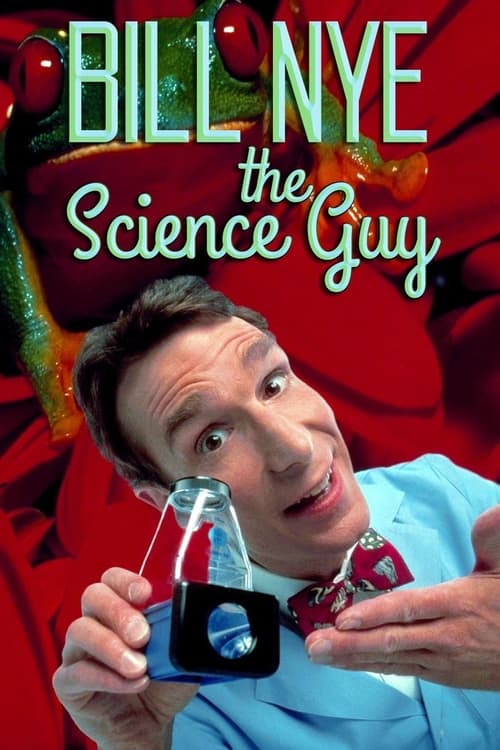
Bill Nye the Science Guy
It's "Mr. Wizard" for a different decade. Bill Nye is the Science Guy, a host who's hooked on experimenting and explaining. Picking one topic per show (like the human heart or electricity), Nye gets creative with teaching kids and adults alike the nuances of science.
Garbage is a look at two different kinds of garbage -- biodegradable and non-biodegradable. Nye emphasizes the importance of recycling and cutting down on the amount of the waste that cannot break down. The music video "Recycle" has a familiar melody, taken from "Respect," the Aretha Franklin hit.
14 S01E14 - Structures
0%
December 10, 199323m0/10
Are you tense? Need some structure to your life? Then tune in to Bill Nye the Science Guy as he explains the science of structures. All structures give support or create a shape. You can find structures everywhere. Bridges, buildings, chairs, shoes, plants, spiderwebs, tables, and even your own body are all structures. A structure's shape, size, and what it's made of depend on what the structure does and how strong it needs to be. When structures give support, they either experience a pull (tension) or a push (compression). Structures in tension, such as ropes, cables, or blimps are made from stuff that is good at pulling. The materials in tension are usually thin. Structures under compression, such as elephant legs and courthouse columns, are made from hard stiff stuff. Compared to structures under tension, structures under compression are much thicker. When it comes to structures, form (the size and shape) depends on function (what it does). Build support for Bill
15 S01E15 - Earth's Seasons
0%
December 17, 199323m0/10
It doesn't matter if it's spring, summer, winter, or fall - Bill Nye is always in season. Every year, we experience the seasons. Some months have snow and rain, while other months have warmth and sunshine. Temperatures go from cold, to woarm, to cold again – winter, spring, summer, and fall. The cycle of the seasons takes one year, and the Earth takes one year to go around the sun. Coincidence? No way. The Earth's orbit around the Sun is flat, as though our planet were spinning over a tabletop. Compared with flat plane of its orbit, the Earth is tilted. Its axis, the imaginary line between the North and South Poles, is tipped over a bit. In June, the north half of the Earth (the Northern Hemisphere) is tilted toward the Sun, and it's summertime in places like Nye Labs in the United States. Meanwhile, the south half (the Southern Hemisphere) is tilted away from the Sun, and it's winter there, in places like Australia and South Africa. The Earth's orbit isn't quite
16 S01E16 - Light & Color
0%
December 24, 199323m0/10
Lighten up. It's the ""Light and Color"" episode. Without light, we wouldn't be able to see. It would be like living in a room with no windows, doors, or lamps. There's an old saying, ""We don't see things; we see light bouncing off of things."" We see things, and colors, when light bounces off things and into our eyes. White light, like the light from the Sun, is made up of all the different colors of light blended together. When white light hits something white, almost all of the light bounces into our eyes, and we see the color white. Things are different colors because some light bounces off and other light gets absorbed. An orange is orange because it absorbs all different colors of light except orange light. Grass is green because it absorbs all different colors of light except green light. Bill Nye's lab coat is blue because it absorbs all different colors of light except blue light. All colors, including black, are made in the same way. It's just a matter of ref
17 S01E17 - Cells
0%
January 21, 199423m0/10
You can't see them, but they're everywhere even inside Bill Nye. This is not science fiction, it's the science of cells. All things that live are made from cells. You can't see them, but every part of your body, including everything inside your body, is made from cells. Cells eat, they grow, and they make more of themselves (what scientists call replicate). There are millions of different types of cells. Dog cells are different from fish cells. Bird cells are different from your cells. And inside your body, there are many different cells, each one doing a different job to keep your body going. Cells may be tiny, but without them, we'd be nothing.
18 S01E18 - Electricity
0%
January 28, 199423m0/10
It's time for Bill Nye to shed a little light on electricity. Electricity might seem mysterious, but once you understand the science the light goes on (so to speak). You flip a switch, and the lights turn on. You push the play button, and your personal stereo starts playing music. When you flip the switch or push play, you start a flow of electrons. Electricity is the flow of electrons, and electrons are very tiny charged particles. Electrons are found in atoms, the tiny pieces that all stuff is made from. We can make electrons flow in two ways. Batteries make electricity by mixing up chemicals -- making a chemical reaction that forces electrons to move in a path from the battery to the personal stereo and back to the battery. Electricity that turns on lights in your home is made by power plants. Most power plants use big machines called generators to make electrons by twirling wire in a magnet. The magnet makes electrons in the wire move around, creating electricity.