
BlockParty

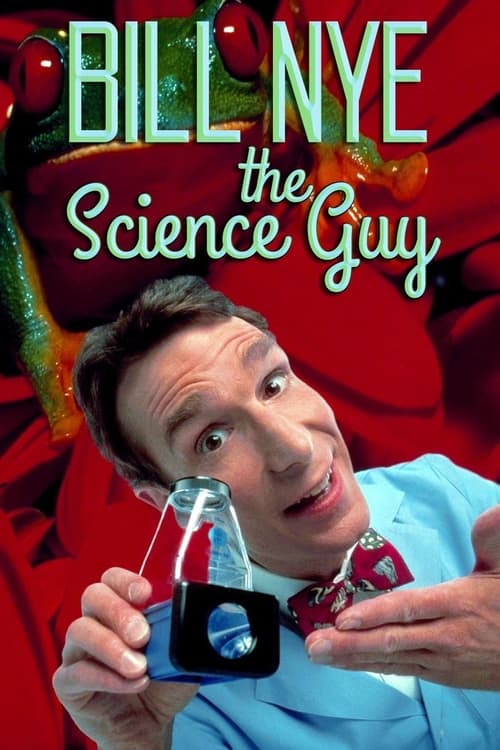
Bill Nye the Science Guy

It's "Mr. Wizard" for a different decade. Bill Nye is the Science Guy, a host who's hooked on experimenting and explaining. Picking one topic per show (like the human heart or electricity), Nye gets creative with teaching kids and adults alike the nuances of science.

100 episodes
Watch List Playlists
Season 1

Episodes

Browse

7 S01E07 - Digestion

0%
October 22, 1993 23m 0/10

Take time to digest this show. They say that your food is no more inside you than a pencil is inside a donut, when it's poked through the hole. Instead of the food going in you, food goes through you. But, all the energy you get to live and grow comes from your food. All the chemicals that become your body and brain as you get bigger, come from your food. You get these vital chemicals through a process called ""digestion."" Your body breaks food down and grabs all the nutrients you need from it. Then, your body gets rid of what's left over. Digestion starts in your mouth. You begin breaking food down by breaking it into pieces with your teeth and jaw muscles. Your saliva (your spit) is full of chemicals that react with the chemicals in food and make them break apart. Then you swallow. Your food goes down a tube (your esophagus) to your stomach, where powerful hydrochloric acid breaks it down further into a mushy mash we call chime (kime). From there, the chime goes in

8 S01E08 - Phases of Matter

0%
October 29, 1993 23m 0/10

Bill Nye is going through a phase - a phase of matter. Check out the ""Phases of Matter"" episode to find out about rock-solid solids, liquidy liquids, and gassy gases. It's phase-tastic! Everything around us is made of stuff called matter, and all matter is made of atoms. Matter is anything that comes in three varieties, what scientists call phases. There are solids like rocks, cookies, and desks. There are liquids like water, honey, and juice. And there are gases, we breathe air and the helium in balloons. The main difference between the three phases is how fast the matter's atoms move. All atoms move around because they have energy. The more energy that's in something, the faster the atoms move. Atoms in an ice cube don't move very much - they're frozen in place. The atoms in liquid water slip and slide around - that's why you can pour it and spill it. Water vapor atoms are moving pretty fast - that's why they float around in air (a mixture of other gasses). Changing

9 S01E09 - Biodiversity

0%
November 5, 1993 23m 0/10

Ecosystems are areas where things live. Ecosystems that are biodiverse are home to a variety of plants and animals. A healthy ecosystem is one with a lot of biodiversity. Imagine if humans could only eat one kind of food, say corn. We'd be in big trouble if all the corn disappeared. Besides not having anything to munch on at the movies, we'd have nothing to eat at all. Luckily, our ecosystem covers a big part of the Earth, and there are lots of different plants to eat. Ecosystems are not as simple as one living thing eating another, as the corn example. The lives of animals and plants are intertwined - what happens to one animal can have an impact on all sorts of living things. As humans, we have a big effect on the other living things around us. We are the only animals to leave lots of stuff around, such as houses, cars, and malls. It's important for us to think about the choices we make and how they will affect the other living things around us. Remember: The Earth

10 S01E10 - Simple Machines

0%
November 12, 1993 23m 0/10

Learning about science can be hard work, but simple machines can make it easier. Let Bill Nye push and pull you around ramps, levers, screws, and pulleys. Simple machines simply make work easier by directing forces over distances. Instead of lifting a heavy box upstairs, you can hook it to some ropes and pulleys and pull it up. Or you can get a ramp and slide it upstairs. Either way, it's less sweat to use the pulleys or the ramp than it is to lift the box straight up by yourself because the force you need is more spread out. Levers, ramps, screws, wheels, wedges, and pulleys are all simple machines designed to direct forces. With simple machines we don't have to push or pull as hard, but we have to push or pull over a longer distance. It's easier to walk up a long set of stairs to the top of the Empire State Building than it would be to climb a ladder to the top, but the set of stairs would be much longer than the ladder. Simple machines are simply scientific.

11 S01E11 - The Moon

0%
November 19, 1993 23m 0/10

Let the moon master Bill Nye teach you the ancient and not-so-ancient secrets of the Moon. Wax on, wax off. The Moon grows bigger (waxes) and smaller (wanes) every 30 days or so. The word ""month"" comes from the word ""moon"". The Moon is the closest thing in space to Earth, and it's one of the most well-studied orbs in our solar system. We know that Moon rocks are rich in calcium and aluminum, that the Moon has no atmosphere, and that there are over a million craters on the Moon's surface. The Moon doesn't glow on its own, it reflects sunlight. Watch the Moon every night for a month as it grows, shrinks, and at one point disappears. The Moon doesn't actually change it's shape. It's the way the sun shines on the part of the Moon we see that makes the phases change. The Earth moves around the Sun, the Moon moves around the Earth. As the Moon moves through its orbit, the Sun shines on bigger or smaller portions of it. If you were looking at the Moon from the Sun, it woul

12 S01E12 - Sound

0%
November 26, 1993 23m 0/10

Listen up, scientists. Bill Nye is here to make some noise in the ""Sound"" episode. Your vocal cords do it. Speakers playing rock music do it. Even a school bell does it. They all vibrate; and that's how sound is made. Plucking a stretched rubber band makes the rubber band vibrate. Air molecules around the rubber band move, pushing other air molecules. As the rubber band continues to vibrate, it sends waves of sound through the air. It's a lot like the ripples you see when you drop a rock into a pond. You hear sound when rippling air pushes on tiny bones in your ears. Nerves in your ears send a message to your brain about the sound you're hearing. Different sounds make different patterns of waves with different distances between them. Plucking, banging, whispering, and yelling are all vibrations in air, yet they all sound very different. Sound vibrations can be thought of as waves moving through molecules. Low-pitched sounds have big gaps between waves, while high-pi